


Creatine & Strength · Complete Guide
Creatine,
Done Right.
The most-researched supplement in sports nutrition — and one of the few that reliably supports strength, power, and recovery when you train.[1] Here's everything that actually matters: the right form, the right dose, and how to make it stick.
Strength & Power
Supports high-intensity output when paired with training.[1]
Faster Recovery
Helps replenish the energy muscles spend during hard efforts.[1]
Most-Studied
Decades of research behind its performance and safety.[1]
Men & Women
Works the same for everyone who trains.[3]
The Basics
What Creatine Does
Creatine helps your muscles regenerate energy during short, hard efforts — which is why it supports strength, power, and training performance.[1] It's not a stimulant or a steroid, and it doesn't work without the work.
How it works
Your body stores creatine in muscle as phosphocreatine. During a heavy set or a sprint, phosphocreatine rebuilds ATP — the fuel your muscles burn first.[1] Keeping those stores topped up means more total work per session, which supports gains in strength and lean mass over time.
What it won't do
Creatine isn't magic. It won't replace training, it isn't a fat-burner, and the "water weight" people worry about sits mostly inside the muscle, not under the skin — and it isn't harmful.[3]
The Big Question
HCl or Monohydrate?
For almost everyone, monohydrate is the smart default — the most-studied, most-proven form.[1] HCl is more soluble and doses smaller, but no form has been shown to out-perform monohydrate.[3]
Monohydrate
- Most-studied, most-proven form [1]
- Full 5,000 mg clinical dose
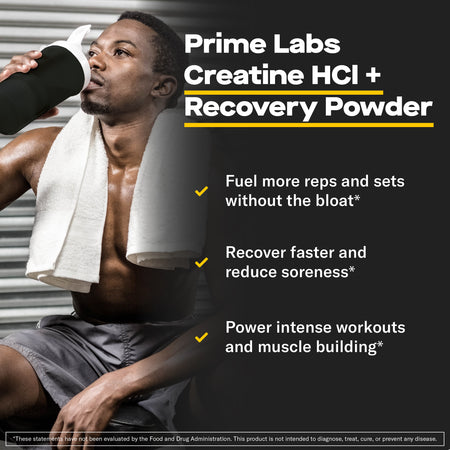
- Supports strength, power & lean muscle*
- Supports faster recovery & endurance*
- Most economical
HCl
- Zero/minimal bloat. Easier on sensitive stomachs
- No loading phase needed, no water retention
- Smaller dose, fast-mixing, rapid absorption
- Just as effective as monohydrate*
Shop the Lineup
Explore Prime Labs Creatine
We make creatine in three forms so you can match it to your routine — capsule or powder, monohydrate or HCl.

Monohydrate · 5,000 mg
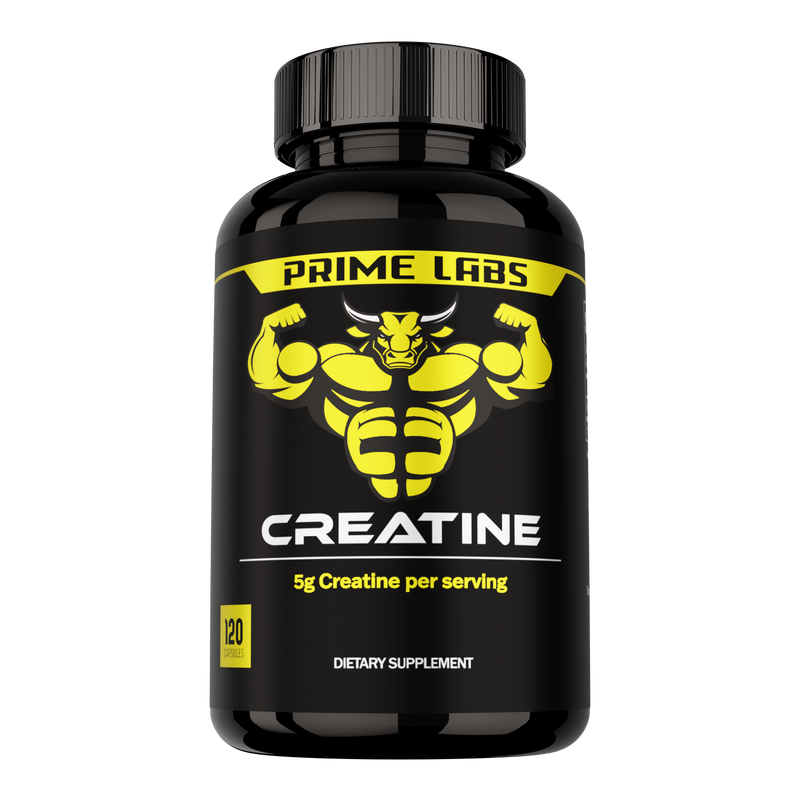
Creatine Capsules
Pure creatine monohydrate — the proven, economical default in a grab-and-go capsule. Full 5,000 mg clinical dose per serving.*

CON-CRĒT® HCl · +Rhodiola & L-Theanine
Creatine HCl+
A smaller, fast-mixing HCl dose with Rhodiola and L-Theanine for focus and calm energy.

CON-CRĒT® HCl · +AstaReal® Astaxanthin
Creatine HCl + Astaxanthin
CON-CRĒT® creatine HCl paired with AstaReal® astaxanthin for added recovery support.
Go Deeper
The Complete Creatine Library
Explore guides covering every question worth asking — form, timing, loading, results, and more.
Buyer's Guide
Best Creatine for Men: How to Choose the Right One
Educational Guide
Best Time to Take Creatine
Educational Guide
Creatine Loading Phase: Is It Necessary?
Educational Guide
How Long Does Creatine Take to Work?
Educational Guide
Types of Creatine Explained
Educational Guide
Does Creatine Cause Bloating?
Quick Answers
Creatine FAQs
For most people, monohydrate is the sensible default — most-studied, most-proven, most economical.[1] HCl suits a smaller dose or a sensitive stomach.
A steady few grams of monohydrate daily; HCl is dosed smaller, often by bodyweight.[1] Follow your product's label and keep it consistent.
No. A loading phase fills stores faster but isn't required — a daily dose reaches the same saturation in three to four weeks.[1]
Creatine is among the most-studied supplements, and in healthy people it hasn't been shown to harm the kidneys.[3] Check with your provider if you have a health condition.
The Science
Research
Physicochemical characterization of creatine N-methylguanidinium salts
View studyCommon questions and misconceptions about creatine supplementation
View studyCreatine supplementation increases total body water without altering fluid distribution
View studyView More
Muscle creatine loading in men
View studyGastrointestinal distress after creatine supplementation in athletes: are side effects dose dependent?
View studyEffects of creatine supplementation and resistance training on muscle strength and weightlifting performance
View studyAcute creatine monohydrate supplementation: a descriptive physiological profile of responders vs. nonresponders
View studyThe effects of pre versus post workout supplementation of creatine monohydrate on body composition and strength
View studyTiming of creatine supplementation around exercise: a real concern?
View studyCarbohydrate ingestion augments skeletal muscle creatine accumulation during creatine supplementation in humans
View studyProtein- and carbohydrate-induced augmentation of whole body creatine retention in humans
View studyCreatine and caffeine: considerations for concurrent supplementation
View studyReady to Start?
Pick a Creatine. Take It Daily.
Monohydrate or HCl — both support strength, power, and recovery when you train. Choose the one you'll keep up with, and let the work do the rest.
*These statements have not been evaluated by the Food and Drug Administration. These products are not intended to diagnose, treat, cure, or prevent any disease.