



THE SHORT VERSION: At the doses research has studied, tongkat ali has been well tolerated. The side effects people reported were mostly mild and digestive. Take it with breakfast, stay at the label serving, and skip the megadose. Those three habits keep you where the research is. The biggest real-world risk isn't the root. It's untested product. Choose a third-party-tested formula with every dose on the label.
"Is it safe?" is the right first question to ask about any supplement, and tongkat ali is no exception. We make a tongkat ali formula, so we've read the safety research closely. Here's the straight answer: what side effects people actually report, how to keep them to a minimum, and what the evidence says about your liver, blood pressure, hair, sleep, medications, and long-term use.
Is Tongkat Ali Safe to Take?
Yes, at studied doses and for the lengths of time studied. In clinical trials using 100–400 mg a day for up to 12 weeks, tongkat ali was well tolerated, and the side effects that did show up were mostly mild and digestive.[1][2][3][4]
Tongkat ali (Eurycoma longifolia) is a shrub native to Southeast Asia. Its root has a long history of traditional use for energy, strength, and male vitality.[5] Modern research uses water extracts of that root, standardized to consistent levels of its key compounds.
The best safety data come from two 12-week placebo-controlled trials. In men aged 50–70, 100 or 200 mg a day produced no clinically relevant changes in liver enzymes, blood lipids, blood pressure, or other vital signs. None of the reported side effects were serious, and none were judged related to the extract.[1] In healthy men aged 30–55 taking 300 mg a day, safety measures were comparable to placebo. The tongkat ali group actually logged fewer adverse events (11) than the placebo group (20).[2]
What Side Effects Do People Report?
Mostly mild stomach complaints. Constipation, indigestion, abdominal discomfort, and gas top the list, with itching reported occasionally.[1][4]
In the 12-week trial in older men, digestive complaints were the most common adverse event: three in each tongkat ali group, plus a single case of itching. None were serious.[1] Across the wider literature, the NIH's liver-safety database lists the side effects most often reported at usual doses:[3]
Digestive: nausea, abdominal discomfort, and diarrhea.
Headache: reported, though less often than stomach complaints.
Skin: rash or itching.
That's the realistic picture. Not a long list of dramatic reactions. A short list of manageable ones. The U.S. Department of Defense's supplement-safety program lands in the same place, naming digestive issues and itching as the side effects seen.[4]
If something feels off and doesn't settle, stop and talk to your doctor. That rule applies to any supplement, and it's the right call here too.
How Do You Keep Side Effects to a Minimum?
Take it with food, follow the label, and stay consistent. These habits won't make side effects impossible, but they target the most common ones directly.
Take it with breakfast. A meal is the simplest way to go easier on your stomach. Our label already pairs the morning serving with breakfast.
Follow the label serving. Two capsules is a full serving. Start there, and stay there unless your doctor advises otherwise.
Take it with water. The label directions call for water, and a full glass helps capsules go down easy.
Keep the routine consistent. Same time, same meal, every day. The trials tested steady daily use, and consistency makes it easier to notice how you respond.
Don't double up on testosterone-support formulas. Combining it with another testosterone-support product stacks overlapping ingredients. If you want a training stack, pair it with creatine and a pre-workout instead.
For exact amounts, see our tongkat ali dosage guide. For morning versus pre-workout timing, see When to Take Tongkat Ali.
The Approach We Don't Recommend: Megadosing
More isn't better. The human studies of tongkat ali on its own used 100 to 400 mg a day, and we found no controlled research above that range.[1][2][6]
Some bodybuilding products sell 1,000–1,600 mg a day, far beyond anything tested in people.[3] That gap matters. The liver-injury case described in the NIH's database involved a bodybuilding product, and anabolic steroid use couldn't be ruled out.[3] Megadosing doesn't buy you more support. It just moves you away from the doses the safety data actually cover.
Our rule is simple. One 2-capsule serving of Prime Labs Tongkat Ali Plus delivers 400 mg of a 100:1 tongkat ali extract, which already sits at the top of the studied daily range. Our label allows a second serving, but research hasn't tested 800 mg a day, so we suggest sticking with one serving unless your doctor agrees otherwise. Extracts differ, so milligram comparisons with study extracts are a guide, not an exact match. The dosage guide explains why.
Is Tongkat Ali Bad for Your Liver?
Not in the controlled research. Twelve-week trials found no meaningful changes in liver enzymes, the blood markers doctors use to check how the liver is handling things.[1][2][3]
The search for "tongkat ali side effects liver" usually traces back to one source. The NIH's LiverTox database rates tongkat ali a possible rare cause of liver injury, its "D" category, based on case reports.[3] The case it describes involved a 47-year-old man who developed jaundice within a week of starting a bodybuilding product, and steroid use couldn't be excluded.[3] Rare and confounded. That's very different from what's been measured at studied doses in controlled trials.
The practical takeaway:
Stay within the studied range. That's where the liver data come from.
Buy a tested product, so you know what's actually in the capsule.
Check with your doctor first if you have a liver condition.
Stop and get checked if you ever notice yellowing of your skin or eyes.
Does Tongkat Ali Raise Blood Pressure?
Not in the research we have. In a 12-week placebo-controlled trial in men aged 50–70, blood pressure and other vital signs showed no clinically relevant changes at 100 or 200 mg a day.[1]
That's one trial in one population, so we won't stretch it into a promise. But it's the best direct data available, and it's reassuring.
The more practical blood-pressure point is about medication. In a small study of healthy young men, a single 200 mg dose of tongkat ali water extract reduced how much of the blood-pressure drug propranolol the body absorbed. Blood pressure itself didn't differ between groups after that single dose.[7] So if you take blood-pressure medication, talk to your doctor before adding tongkat ali.
Does Tongkat Ali Cause Hair Loss?
There's no evidence either way, because it hasn't been studied. We found no human trial that measured hair loss or DHT.
The concern comes from DHT (dihydrotestosterone), a hormone the body makes from testosterone. The logic runs: anything that touches testosterone might touch DHT, and DHT is associated with hair thinning. That's a reasonable question, but nobody has tested it with tongkat ali.
In the trials, testosterone changes were modest, and in healthy men aged 30–55, testosterone didn't change significantly at all.[1][2] Hair loss doesn't appear among the side effects reported in the controlled trials or in the NIH's summary of reported effects.[1][3]
So there's no basis for calling hair loss a known tongkat ali side effect. If you're already managing hair thinning, or taking medication for it, mention tongkat ali to your doctor so they have the full picture.
Can Tongkat Ali Affect Your Sleep?
There's no trial evidence that it disrupts sleep. In a 4-week placebo-controlled trial at 400 mg a day, sleep quality scores didn't differ from placebo.[6]
Individual responses still vary, and a formula built to support energy, drive, and motivation* makes most sense early in the day. That's why our label points to a morning serving with breakfast, or 30–45 minutes before training. If you train in the evening and find it keeps you wired, move it earlier. Our guide on when to take tongkat ali covers the options.
Does Tongkat Ali Interact With Medications?
It can. The clearest human example is propranolol: in a small crossover study, tongkat ali taken alongside the drug lowered its absorption by about 29% and its peak blood level by about 42%.[7]
That doesn't mean tongkat ali interacts with everything. It means the possibility is real enough to check before you combine. The same rule applies to every herbal supplement: tell your doctor what you take.
If you take any prescription medication, and especially blood thinners, antidepressants (including SSRIs and MAOIs), hormone medications, or blood-pressure drugs, talk to your doctor before starting tongkat ali. Bring the bottle. A label with every dose disclosed makes that conversation faster.
The Real Safety Risk: Untested Products
Choose the product as carefully as the ingredient. The most serious documented tongkat ali problems come from products that weren't what their labels said.
Heavy metals. When researchers tested 100 tongkat ali products sold in Malaysia, 36% contained mercury above the national limit.[8]
Hidden drugs. Singapore's health regulator found a "tongkat ali" capsule spiked with undeclared tadalafil, a prescription drug that can cause serious reactions.[9]
A continuing pattern. The Department of Defense's supplement-safety program notes tongkat ali products have been reported contaminated with lead and mercury, or adulterated with sildenafil.[4]
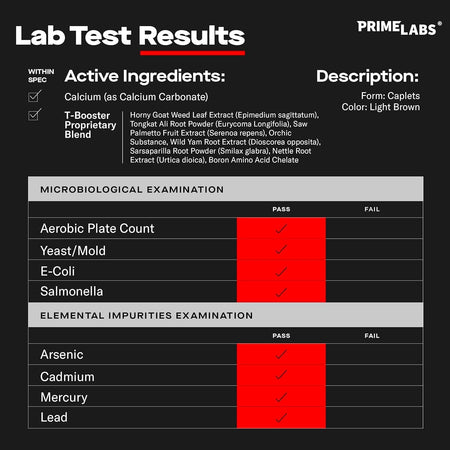
The FDA doesn't approve supplements before they're sold, so quality is the manufacturer's responsibility.[10] That puts the burden on the brand to prove what's in the bottle. Outside lab testing is how a product shows it was properly made, contains what the label lists, and doesn't carry harmful levels of contaminants. It's a quality check, not a promise of safety or effectiveness.[11]
Prime Labs Tongkat Ali Plus is third-party tested, and every ingredient dose is on the label. No proprietary blend. No synthetic hormones. For the full checklist we use, see Best Tongkat Ali Supplement: Quality Markers to Look For.
What Do We Know About Long-Term Safety?
Less than we'd like, and we'll say so plainly. Most human research runs up to about 12 weeks. The longest trial ran 6 months, in middle-aged men, some of whom also did structured exercise training.[1][2][12] The NIH notes that long-term safety hasn't been well documented in humans.[3]
One regulatory point belongs in any honest safety article. European food-safety regulators (EFSA) have not authorized a standardized tongkat ali extract as a novel food. In 2021, their panel concluded its safety had not been established, citing genotoxicity questions, meaning possible DNA damage, from lab tests and an animal test at a very high dose of 2,000 mg per kilogram of body weight.[13] There's no human evidence of harm. A separate animal study of powdered root, a different material, found no genetic toxicity.[14] But the question isn't settled, which is one more reason we keep to studied doses.
Our convention is also to cycle: 8–12 weeks on, then 2–4 weeks off. That's our practice and a matter of preference, not a research-tested protocol. We cover it in How Long Does Tongkat Ali Take to Work, and Should You Cycle It?
Check With Your Doctor First If…
Tongkat Ali Plus is made for healthy adult men. Talk to your doctor before you start if any of these apply:
You take prescription medication, especially blood thinners, SSRIs, MAOIs or other antidepressants, hormone medications, or blood-pressure drugs.
You have a hormone-sensitive condition.
You have a kidney or liver condition.
Tongkat Ali Plus isn't intended for women or anyone under 18.